
The short answer
The binomial theorem tells you how to expand (a + b)n without multiplying n brackets one by one. The expansion is printed on the 4049 formula list, so you do not need to memorise it, but you must practise using ⁿCᵣ and the general term, because the formula list will not do the working for you. This guide covers the formula, Pascal’s triangle, the general term and six worked examples, from a simple expansion to finding an unknown n.
On this page
The binomial theorem formula
For a positive integer n:
(a + b)n = an + ⁿC₁ an−1b + ⁿC₂ an−2b2 + … + ⁿCᵣ an−rbr + … + bn
Three things to notice. The powers of a go down from n to 0. The powers of b go up from 0 to n. In every term, the two powers add up to n. There are n + 1 terms altogether.
What ⁿCᵣ means, and Pascal’s triangle
ⁿCᵣ is the number of ways to choose r items from n, and it is worked out as n! ÷ (r! × (n − r)!). On your calculator, use the nCr key. For example, ⁸C₃ = 56 and ⁷C₄ = 35. Two useful facts: ⁿC₀ = ⁿCₙ = 1, and ⁿCᵣ = ⁿCₙ₋ᵣ.
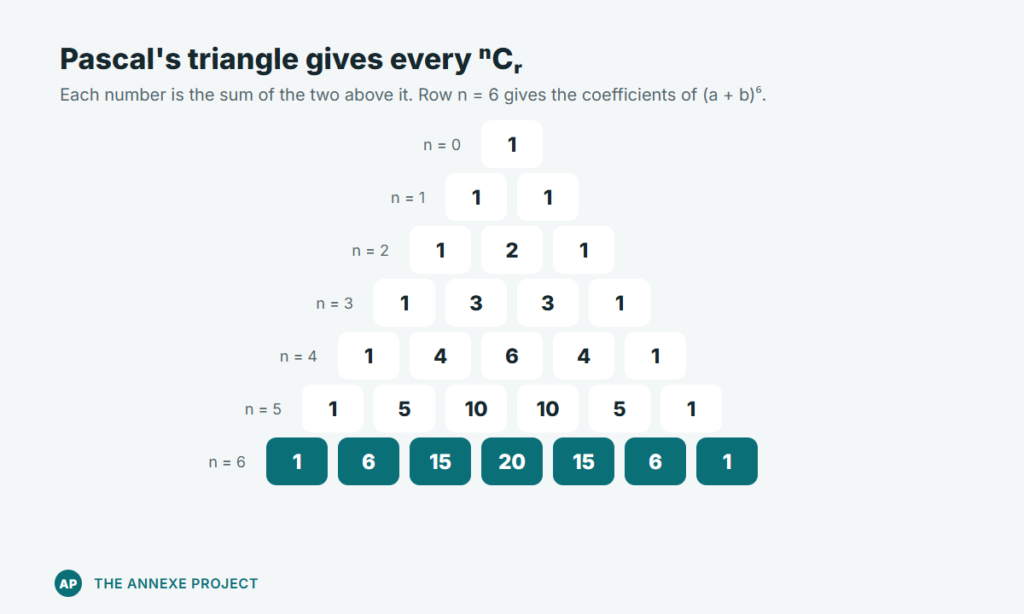
For small n, you can read the coefficients straight from Pascal’s triangle. Each number is the sum of the two numbers above it.
The general term
When a question asks for one particular term, do not expand everything. Use the general term, which is the (r + 1)th term:
Tr+1 = ⁿCᵣ an−r br
Note that the first term is r = 0, so the (r + 1)th term has b raised to the power r. Students who write Tr instead of Tr+1 are often one term off.
Worked examples
Worked example 1: Expand (1 + 2x)4 fully
Here a = 1, b = 2x and n = 4. The coefficients from Pascal’s triangle are 1, 4, 6, 4, 1.
(1 + 2x)4 = 1 + 4(2x) + 6(2x)2 + 4(2x)3 + (2x)4
= 1 + 8x + 24x2 + 32x3 + 16x4
Remember that the 2 is also raised to the power, so (2x)2 = 4x2, not 2x2.
Worked example 2: Find the coefficient of x3 in the expansion of (2 − x)6
Take a = 2, b = −x, n = 6. For x3, we need r = 3.
T4 = ⁶C₃ (2)3 (−x)3 = 20 × 8 × (−x3) = −160x3
The coefficient of x3 is −160. The negative sign comes from (−x)3. With an odd power, the minus sign stays.
Worked example 3: Find the term independent of x in the expansion of (x + 2/x)6
“Independent of x” means the power of x is 0. Write the general term with a = x, b = 2/x:
Tr+1 = ⁶Cᵣ x6−r (2/x)r = ⁶Cᵣ 2r x6−r x−r = ⁶Cᵣ 2r x6−2r
Set the power of x to zero: 6 − 2r = 0, so r = 3.
T4 = ⁶C₃ × 23 = 20 × 8 = 160
The term independent of x is 160. The method is always the same: combine the powers of x, set the total to 0, solve for r, then substitute.
Worked example 4: Find the first three terms of (1 + 2x)(2 − x)5 in ascending powers of x
First expand (2 − x)5 up to x2:
(2 − x)5 = 25 + ⁵C₁(2)4(−x) + ⁵C₂(2)3(−x)2 + … = 32 − 80x + 80x2 + …
Now multiply by (1 + 2x) and collect only the terms up to x2:
- Constant: 1 × 32 = 32
- x: (1 × −80x) + (2x × 32) = −80x + 64x = −16x
- x2: (1 × 80x2) + (2x × −80x) = 80x2 − 160x2 = −80x2
The first three terms are 32 − 16x − 80x2. There is no need to expand beyond x2, which saves time in the exam.
Worked example 5: The coefficient of x2 in the expansion of (1 + 2x)n is 180. Find n
The x2 term is T3 = ⁿC₂ (1)n−2 (2x)2 = 4 × ⁿC₂ x2.
So 4 × ⁿC₂ = 180, which gives ⁿC₂ = 45.
Using ⁿC₂ = n(n − 1) ÷ 2: n(n − 1) = 90, so n2 − n − 90 = 0, which factorises to (n − 10)(n + 9) = 0.
Since n must be a positive integer, n = 10. You can check: ¹⁰C₂ = 45 and 4 × 45 = 180.
Worked example 6: Use the expansion of (1 + 0.02)5 to estimate 1.025
Because 0.02 is small, the later terms shrink very quickly, so the first few terms are enough.
(1 + 0.02)5 = 1 + 5(0.02) + 10(0.02)2 + 10(0.02)3 + …
= 1 + 0.1 + 0.004 + 0.00008 + …
= 1.10408 (using four terms)
So 1.025 ≈ 1.1041 to 4 decimal places. The calculator value is 1.1040808…, so the approximation is very close. Questions like this usually say how many terms to use, so read the instruction carefully.
Stuck on expansions or finding a particular term? Our A-Math tuition works through topics like this step by step until the method feels natural. It is part of our live online math tuition for Singapore students.
A note for H2 Mathematics students
At JC level, the binomial expansion is extended to (1 + x)n for any rational n, including negative and fractional values. The series does not stop, and it is only valid when |x| < 1. This version is given in the MF27 formula list. The skill that stays the same is careful substitution and tidy working with the coefficients.
Common mistakes to avoid
- Forgetting to raise the coefficient to the power. In (2x)3, the answer is 8x3, not 2x3.
- Losing the minus sign. In (2 − x)6, b is −x, so odd powers of b are negative.
- Using Tr instead of Tr+1 for the general term, which gives the wrong term number.
- Expanding the whole expression when only one term or the first few terms are needed.
- In products such as (1 + 2x)(2 − x)5, missing a cross-term. Check every way two terms can multiply to give the required power.
- For “independent of x” questions, forgetting that 1/x is x−1 when combining powers.
- Mixing up ⁿCᵣ with ⁿPᵣ on the calculator.
Frequently asked questions
Is the binomial theorem formula given in the O-Level A-Math exam?
The expansion of (a + b)n is printed on the 4049 formula list. You still need to know how to read ⁿCᵣ, find the general term, and handle negative and fractional terms, so practise those rather than memorising the line.
How many terms are there in the expansion of (a + b)n?
There are n + 1 terms. For example, (1 + 2x)4 has 5 terms, from the constant term up to the x4 term.
How do I find the term independent of x?
Write the general term, combine all the powers of x into one power in terms of r, and set that power equal to 0. Solve for r, then substitute back to get the value of the term.
What is the difference between binomial expansion in A-Math and H2 Math?
In O-Level A-Math, n is a positive integer and the expansion is finite. In H2 Mathematics, n can be any rational number, the series is infinite, and it is valid only when |x| < 1.
Do I need Pascal’s triangle if I have the nCr key?
No, but Pascal’s triangle is quick for small n, such as n up to 6, and helps you check your calculator answers. For larger n, the nCr key is faster and more reliable.
Keep practising
The binomial theorem rewards steady practice, because the same few moves appear in almost every question. If you would like guided help, see our A-Math tuition, check the other formulae you will need in our O-Level A-Math formula sheet guide, and try past-paper questions with worked answers in the A-Math model solutions.
