
The short answer
A good E-Math tuition class in Singapore covers the whole O-Level Elementary Mathematics syllabus (4052), teaches clean working that earns method marks, and trains speed for two papers of 2 hours 15 minutes each. Students usually gain the most when they start in Sec 3, but Sec 4 students can still improve with weekly timed practice. Before paying, ask who teaches, how big the class is, how homework is marked, and for results by year.
On this page
Does your child need E-Math tuition?
Elementary Mathematics is the O-Level maths subject every candidate takes, and a strong grade keeps both polytechnic and junior college options open. Not every student needs a tutor. These signs suggest that extra help would be worthwhile:
- Test marks keep dropping, or stay stuck at the same grade despite more practice.
- Your child understands a worked example but cannot start a similar question alone.
- Marks disappear to “careless mistakes”. These are often gaps in method rather than carelessness.
- Papers are not finished on time.
- Word problems cause more trouble than the calculations inside them.
If school marks are steady and your child can explain how they solved a question, focused past-paper practice at home may be enough. Our free E-Math past-paper model solutions are a good place to begin.
When to start
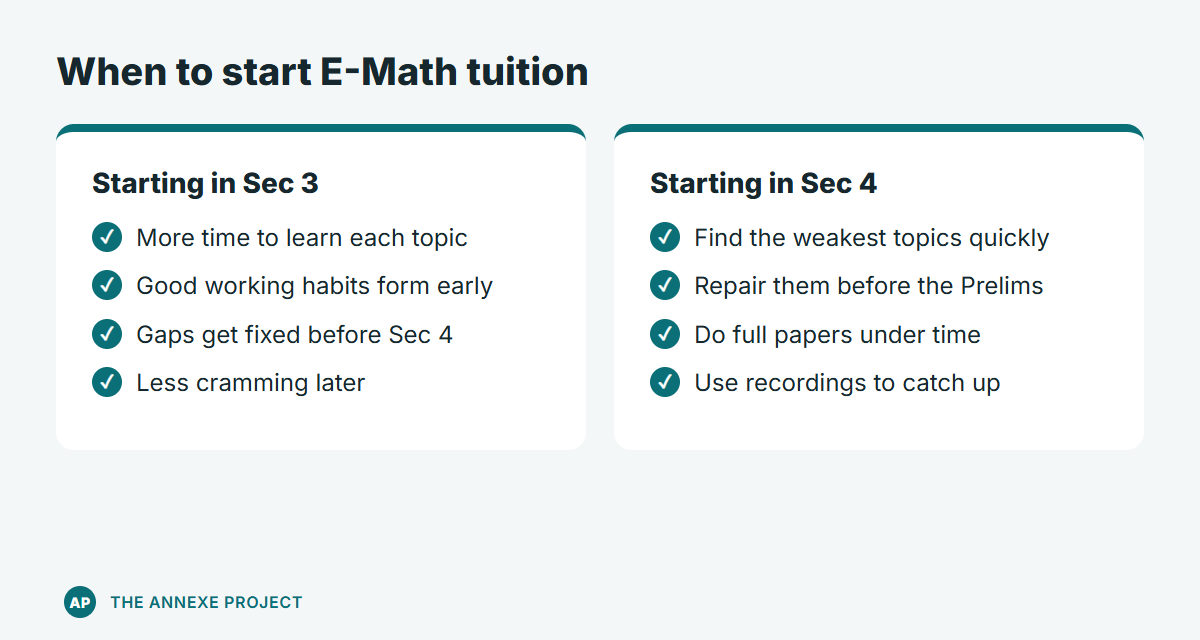
Starting in Sec 3 gives a student time to learn each topic properly, build habits for showing working and fix gaps before the O-Level year.
Starting in Sec 4 is also common. The plan has to be tighter: find the weakest topics quickly, repair them, then move to full papers under time. Lesson recordings help because a student can revisit an earlier topic at home.
The sooner the gaps are found, the more time there is to fix them. Tuition that begins just before the exam is mostly revision rather than teaching.
What good E-Math tuition includes
| What to look for | Why it matters |
|---|---|
| The full 4052 syllabus | Both papers can draw on Numbers and Algebra, Geometry and Measurement, and Statistics and Probability. |
| Line-by-line working | Students learn steps they can reuse on similar questions, and which earn method marks. |
| A small class | The tutor has time to notice and correct each student’s mistakes. |
| Homework reviewed every week | Gaps show up early instead of at the Prelims. |
| Timed practice | Each paper is 2 hours 15 minutes and 90 marks, so speed has to be trained. |
| Recordings and consultations | A missed or confusing lesson can be caught up. |
| Results published by year | Shows how past students did, including the less impressive years. |
Keep the O-Level maths formula sheet nearby during practice, so your child learns which formulas are given and which must be memorised.
Six questions to ask a tutor
- Who will actually teach the class? Ask whether it is the person named on the website, and whether that could change during the year.
- How many students are in a class? Then ask how the tutor checks each student’s working.
- Who marks the homework? Ask how soon feedback comes back.
- What are your E-Math results for each of the last five years? Be wary of a single best-year figure, or a figure that combines several subjects.
- What happens if my child misses a lesson? A recording is the simplest answer.
- Can we try a lesson first? A trial shows whether your child can follow this tutor’s teaching.
E-Math and A-Math together
Many students take both subjects. They support each other: strong algebra helps in both, and A-Math practice often makes E-Math algebra feel easier. They are still different papers, and E-Math has topics of its own, such as statistics, probability and mensuration. A student doing well in A-Math can still lose marks in E-Math by neglecting them. See our guide to online math tuition if you are also deciding between online and centre classes.
Looking for E-Math help? See how our E-Math tuition works, or book a trial lesson.
Our E-Math class in numbers
The Annexe Project’s E-Math tuition is a live, small-group online class for Sec 3 and Sec 4, taught by founder Mr Alvin Yeo for 1.5 hours a week. Notes arrive before class, homework is reviewed by the tutor, and every lecture is recorded.
| O-Level year | Our E-Math students scoring A1 or A2 |
|---|---|
| 2025 | 100% |
| 2024 | 100% |
| 2023 | 57.1% |
| 2022 | 83.3% |
| 2021 | 85% |
Percentages are the share of that year’s Annexe Project E-Math cohort, as announced to parents on results day. Past results do not promise a future grade.
Frequently asked questions
When should my child start E-Math tuition?
Sec 3 gives the most time to build strong habits and fix gaps. Sec 4 students can still improve with focused catch-up and regular timed papers, ideally starting well before the Prelims.
How is the O-Level E-Math exam structured?
There are two papers of 2 hours 15 minutes, worth 90 marks each. Both cover the 4052 syllabus.
Is E-Math tuition worth it if my child is already passing?
It can be. Moving from a B to an A is often about complete working, accuracy and speed, which regular feedback can train. If your child is improving steadily without help, past-paper practice at home may be enough.
What is the difference between E-Math and A-Math?
E-Math (4052) is the O-Level maths subject every candidate takes. A-Math (4049) is an elective with more abstract topics such as calculus, logarithms and trigonometric identities.
Does online E-Math tuition work?
It can work well when the class is live and small, so the tutor can see each student’s working and answer questions. Recordings also make it easy to go over a topic again.
