
The short answer
MF27 is the official List of Formulae and Results that SEAB gives you in the A-Level H2 Mathematics papers. It is 8 pages long and covers series, trigonometry, calculus tables, vectors, numerical methods and statistics. It does not print everything: the arithmetic and geometric series formulae, the Pythagorean identities and the differentiation rules are not in it, so you must learn those yourself.
On this page
Students also call MF27 the “data booklet” or “formula booklet”. The same list is used for H1, H2 and H3 Mathematics and H2 Further Mathematics, from 2025 onwards. This guide explains what is inside, what is missing, which parts H2 students actually need, and how to use it while revising.
Where to get the official MF27
SEAB publishes MF27 on its syllabus pages. Download it from the SEAB 2026 A-Level syllabus page (look for “List of Formulae and Results (MF27)”). Print it and keep it beside you as you read. We do not host a copy, so you always work from the current official version.
The 9758 syllabus states that candidates “will be provided in the examination with a list of formulae and results”. You do not need to prepare your own copy for the paper, but you do need to know it well enough to find things fast.
What is inside MF27?
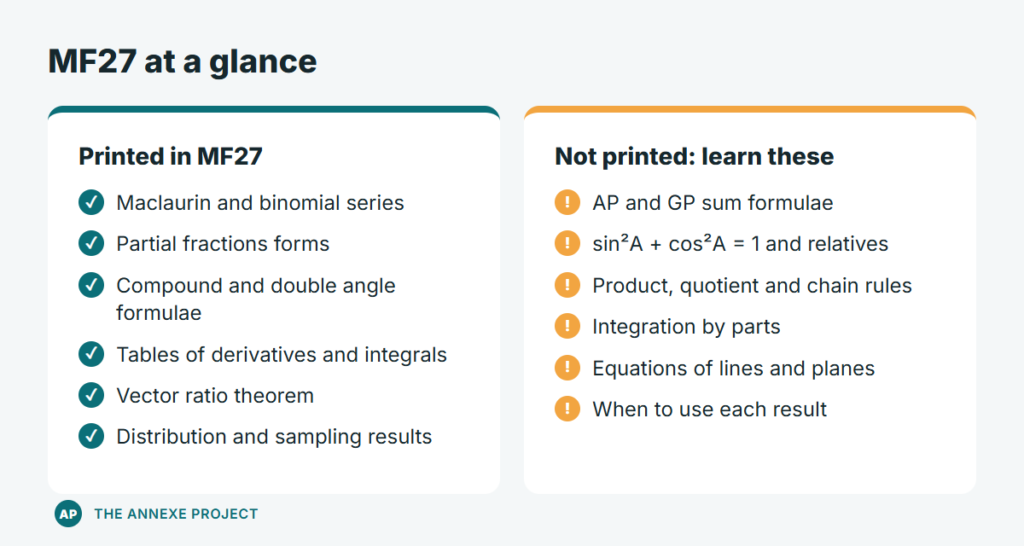
The booklet is arranged by topic. Here is what it prints, based on the official document.
| Section | What it gives you |
|---|---|
| Algebraic series | Binomial expansion of (a + b)n for positive integer n; Maclaurin expansion of f(x); standard series for (1 + x)n, ex, sin x, cos x and ln(1 + x), with the range of x for which each is valid |
| Partial fractions | The standard forms for non-repeated linear factors, repeated linear factors, and a non-repeated quadratic factor |
| Trigonometry | Compound angle formulae for sin, cos and tan; double angle formulae; principal values of sin-1x, cos-1x and tan-1x |
| Derivatives | sin-1x, cos-1x, tan-1x, cosec x and sec x |
| Integrals | Standard results for 1/(x2 + a2), 1/√(a2 – x2), 1/(x2 – a2), 1/(a2 – x2), tan x, cot x, cosec x and sec x |
| Vectors | Position vector of the point dividing a line in a given ratio; the vector product in components |
| Applications of definite integrals | Arc length and surface area of revolution (cartesian form) |
| Functions of two variables | Quadratic approximation of f(x, y) near a point |
| Numerical methods | Trapezium rule, Simpson’s rule, Newton-Raphson, Euler and improved Euler methods |
| Distributions | Probability functions, means and variances for the binomial, Poisson, geometric and exponential distributions |
| Sampling, regression and tests | Unbiased estimate of population variance; correlation coefficient; regression line of y on x; Wilcoxon signed rank critical values |
| Mathematical results | AM-GM, Cauchy-Schwarz and triangle inequalities; the inclusion-exclusion principle |
What MF27 does not give you
This catches many students out. MF27 is a reference, not a substitute for learning. Going through the booklet, these common items are not printed, so learn them:
- The nth term and sum formulae for arithmetic and geometric series, and the sum to infinity
- The Pythagorean identities, sin2A + cos2A = 1 and its relatives
- The derivatives of xn, sin x, cos x, tan x, ex and ln x, and the product, quotient and chain rules
- Integration by parts and the basic integrals such as ∫ xn dx and ∫ ex dx
- The scalar product and the equations of lines and planes
- When to use each result, and how to set a question up
Which parts of MF27 do H2 Math students need?
MF27 is shared across several syllabuses, so some of it is not for H2. The 9758 content outline (2026) does not list the Poisson, geometric or exponential distributions, the Wilcoxon test, the numerical methods, arc length, surface area or functions of two variables. Those belong to H2 Further Mathematics or H3. If you are an H2 student, do not spend revision time on them.
SEAB has also published the 9758 syllabus for 2027. We compared it with the 2026 document and found no change to the paper structure or the content outline. MF27 is still the list named on the 2027 page.
Worked examples: using MF27 well
The skill is knowing the result is there, then applying it carefully. Here are seven short examples.
1. Maclaurin series by substitution
Question: Find the Maclaurin series for e2x up to the term in x3.
MF27 gives ex = 1 + x + x2/2! + x3/3! + … Replace x with 2x:
e2x = 1 + 2x + (2x)2/2! + (2x)3/3! + … = 1 + 2x + 2x2 + (4/3)x3 + …
2. The series for (1 + x)n with a fraction
Question: Expand (1 + x)-1/2 up to the term in x2, and state when it is valid.
Use (1 + x)n = 1 + nx + n(n – 1)x2/2! + … with n = -1/2. The x2 coefficient is (-1/2)(-3/2)/2 = 3/8. So (1 + x)-1/2 = 1 – x/2 + (3/8)x2 + …, valid for |x| < 1.
3. Partial fractions
Question: Express (5x + 1) / [(x – 1)(x + 2)] in partial fractions.
MF27 shows the form A/(x – 1) + B/(x + 2). Then 5x + 1 = A(x + 2) + B(x – 1). Put x = 1: 6 = 3A, so A = 2. Put x = -2: -9 = -3B, so B = 3. The answer is 2/(x – 1) + 3/(x + 2).
4. A compound angle value
Question: Find the exact value of sin 75°.
Write 75° = 45° + 30° and use sin(A + B) = sin A cos B + cos A sin B:
sin 75° = (√2/2)(√3/2) + (√2/2)(1/2) = (√6 + √2)/4.
5. A standard integral
Question: Find ∫ 1/(x2 + 9) dx.
Compare with the MF27 result for 1/(x2 + a2), which integrates to (1/a) tan-1(x/a). Here a = 3, so the answer is (1/3) tan-1(x/3) + c.
Want someone to check your method on questions like these? Our H2 Math tuition classes are part of our live online math tuition in Singapore, taught in small groups by Mr Alvin Yeo.
6. Vectors: dividing a line in a ratio
Question: A is (2, 0, 1) and B is (8, 6, 4). Find the point P on AB with AP : PB = 1 : 2.
The ratio theorem in MF27 gives the position vector of the point dividing AB in the ratio λ : μ as (μa + λb)/(λ + μ). With λ = 1 and μ = 2, P = (2a + b)/3 = ((4 + 8)/3, (0 + 6)/3, (2 + 4)/3) = (4, 2, 2).
7. Unbiased estimate of variance
Question: For a sample of n = 5, Σx = 20 and Σx2 = 95. Find the unbiased estimate of the population variance.
MF27 gives s2 = (1/(n – 1)) [Σx2 – (Σx)2/n]. So s2 = (1/4)(95 – 400/5) = (1/4)(15) = 3.75.
How to use MF27 while you revise
- Learn the layout early. Print a spare copy and mark the page for each chapter. You should find any result in a few seconds, because time is tight over three hours.
- Do early practice with the booklet open. Notice which results you keep looking up. Those are the ones to learn properly.
- Do a no-booklet round later. Attempt a question first, then open the booklet to check. This shows you what you really know.
- Practise on real papers. Past papers show how the results are used under exam conditions. Try the 2025 H2 Mathematics Paper 1 solution and Paper 2 solution, or browse all the H2 Math model solutions.
Common mistakes with the formula list
- Using it only in the last week. You lose the chance to build speed.
- Ignoring the range of validity. The standard series only work for certain values of x, and MF27 states them.
- Mixing radians and degrees. The Maclaurin series for sin x and cos x are for x in radians.
- Assuming a result is printed. If you are not sure, check the booklet now, not in the exam.
Frequently asked questions
What is MF27?
MF27 is the List of Formulae and Results issued by SEAB for the Singapore-Cambridge A-Level Mathematics papers. It is for use from 2025 in H1, H2 and H3 Mathematics and H2 Further Mathematics, and it has 8 pages.
Is the MF27 formula list given in the exam?
Yes. The 9758 syllabus says candidates will be provided in the examination with a list of formulae and results.
Is MF27 the same for H1 and H2 Math?
The same booklet is used for H1, H2 and H3 Mathematics and H2 Further Mathematics. You only need the sections that match your own syllabus.
Does MF27 include every formula I need for H2 Math?
No. It leaves out items such as the arithmetic and geometric series formulae, the Pythagorean identities and the basic differentiation rules. Learn those from your notes.
Where can I download the MF27 PDF?
From the SEAB A-Level syllabus page for the year of your exam. The 2026 page is linked near the top of this guide.
Next steps
A formula list helps you recall, but marks come from knowing when to use each result. The Annexe Project has taught A-Level H2 Math since 2008, when Mr Alvin Yeo founded it. See how the live online classes work on our H2 Math tuition page, then practise with the step-by-step model solutions library. For a topic-by-topic overview, read our H2 Mathematics syllabus explained guide.
