
The short answer
The H2 Mathematics syllabus (code 9758) is set by MOE and SEAB. It has one Pure Mathematics section and one Probability and Statistics section. The exam is two 3-hour papers. Each paper is marked out of 100 and each carries 50 per cent of the final mark. Every question must be answered, and a graphing calculator is expected.
On this page
- What is the H2 Mathematics syllabus 9758?
- What topics does the H2 Mathematics syllabus cover?
- How is H2 Mathematics examined?
- Want worked answers to real exam questions?
- What is the Holy Grail that students mention?
- How should you prepare for H2 Mathematics?
- Frequently asked questions
- Get help with A-Level H2 Mathematics
Updated October 2026. First published May 2022. The syllabus details below follow the official SEAB 9758 document for the 2026 examination.
What is the H2 Mathematics syllabus 9758?
If you are sitting your A-Level H2 Mathematics examination, you are probably wondering which topics will be tested. The syllabus number is 9758. SEAB, the Singapore Examinations and Assessment Board, publishes the full document, which you can read here: Syllabus 9758 for the 2026 examination (PDF).
This post first appeared when the syllabus was introduced for the 2021 examination. We have kept the original explanation and checked it against the current document so you are not studying from an outdated page. Always confirm the details for your own exam year on the SEAB website, because the syllabus is issued year by year.
According to the syllabus, H2 Mathematics prepares students for university courses in mathematics, the sciences, engineering and related fields where a strong foundation in mathematics is needed. That is why it covers a wide range of topics, from equations and inequalities to vectors, calculus, statistics and complex numbers.
What topics does the H2 Mathematics syllabus cover?
The syllabus has two sections. Section A is Pure Mathematics and Section B is Probability and Statistics. In the SEAB document, the topics are:
- Functions and graphs: functions, composite and inverse functions, the conditions for them to exist, domain restrictions, graphs and transformations, simple parametric equations and their graphs, and equations and inequalities
- Sequences and series: sequences and series for finite and infinite cases, sequences as functions, the sum and difference of series, convergence, the sum to infinity and infinite geometric series
- Vectors: basic properties of vectors in two and three dimensions, scalar and vector products, and three-dimensional vector geometry
- Introduction to complex numbers: complex numbers in Cartesian form and the Argand diagram
- Calculus: differentiation, Maclaurin series, integration techniques, definite integrals and differential equations
- Probability and statistics: probability, discrete random variables, normal distribution, sampling, hypothesis testing, and correlation and linear regression
A correction to our earlier version: the syllabus excludes complex numbers in polar (modulus-argument) form and exponential form. If an older page, video or set of notes teaches them, you can skip that part for 9758.
These topics can look abstract, but the syllabus lists real uses for each. Functions, calculus and vectors appear in kinematics and dynamics, such as free fall, projectile motion and collisions. Complex numbers and calculus appear in electrical circuits. Normal distribution and sampling appear in standardised testing, market research and clinical research. The syllabus also says questions may combine ideas from more than one topic.
How is H2 Mathematics examined?
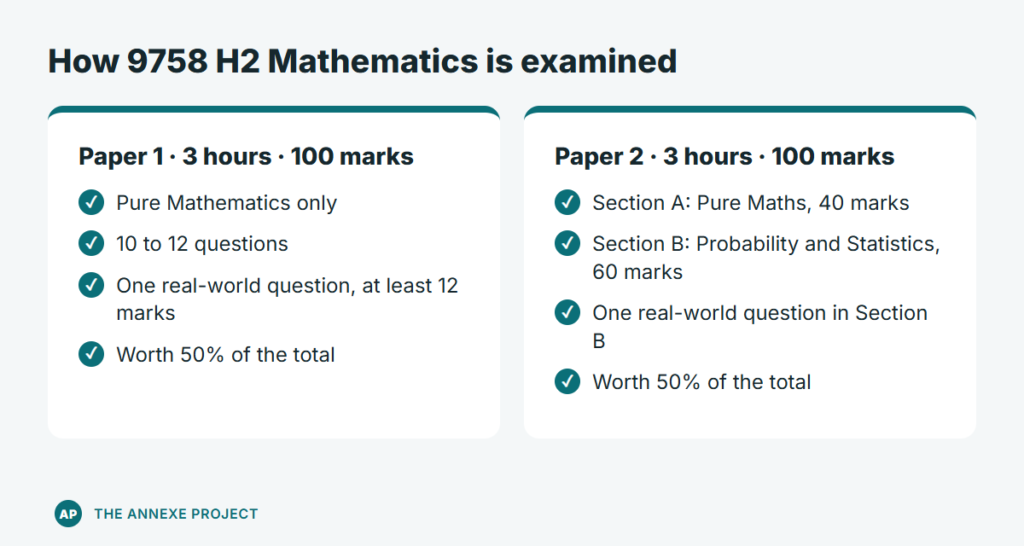
There are two 3-hour papers, six hours in total. Each paper is marked out of 100 and carries 50 per cent of the total mark.
Paper 1 (3 hours)
- 10 to 12 questions of different lengths and marks, all based on Pure Mathematics
- One question on the application of mathematics in real-world contexts, including contexts from science and engineering. It carries at least 12 marks and may need skills from more than one topic
- You must answer all questions
Paper 2 (3 hours)
- Section A, Pure Mathematics, is worth 40 marks and has 4 to 5 questions
- Section B, Probability and Statistics, is worth 60 marks and has 6 to 8 questions
- Section B includes one real-world application question worth at least 12 marks
- You must answer all questions
Our earlier version said “at least two” application questions in Paper 1 and Section B. The current syllabus says one in each, so we have corrected it.
The syllabus also gives approximate weightings for what the questions test: about 30 per cent for recalling and using standard methods, 60 per cent for formulating and solving problems, including real-world ones, and 10 per cent for reasoning and communicating mathematically. In practice, most of your marks come from choosing the right method for an unfamiliar problem, not from repeating a drill.
You will use an approved graphing calculator without computer algebra, and you will be given a list of formulae and results in the exam. Where a question says a calculator is not allowed, you must show your steps in proper mathematical notation. Our guide to the MF27 formula list shows what is provided and what you still need to memorise.
Want worked answers to real exam questions?
Reading the syllabus tells you what is tested. Seeing full solutions shows you how marks are earned. Browse our model solutions library for past H2 Mathematics papers, or look at our H2 Mathematics tuition to see how live online classes work.
What is the Holy Grail that students mention?
Many students search for “Holy Grail MOE” and expect an official source. Holy Grail (grail.moe) is a free online library of notes and practice papers made by and for Singapore students. By its own description it is a collaborative student initiative, and it is not run by MOE or SEAB. The “moe” is part of its web address. Notes shared there come from many contributors, so use the SEAB syllabus above as your checklist for what is examinable, and check any notes against it.
How should you prepare for H2 Mathematics?
At this point you may feel the syllabus is broad. These steps help students approach it calmly.
- Revise the assumed knowledge first. SEAB assumes you know O-Level Mathematics, and it lists the O-Level Additional Mathematics content it expects as well, such as quadratics, surds, polynomials, partial fractions and trigonometry. Gaps here slow down every later topic. Our O-Level Additional Mathematics tuition page covers that foundation.
- Study by topic, then mix. Learn each topic on its own, then practise questions that combine two or three topics, because the syllabus says questions can do exactly that.
- Practise the application question early. There is a real-world question in Paper 1 and one in Paper 2 Section B. Read the context slowly, define your variables, and interpret your final answer in words.
- Use your graphing calculator with care. Know which questions allow it, and practise writing the working in notation when it does not.
- Do past papers under time. Each paper is three hours. Practise full papers, then compare your working with a full solution to see where marks were lost.
- Fix weak topics before they pile up. Short, targeted online math tuition can help with the harder topics.
Frequently asked questions
What is the H2 Mathematics syllabus code?
The code is 9758. The full document is on the SEAB website, and there is a new version for each examination year.
How many papers are there in H2 Mathematics?
There are two papers, each 3 hours long, each marked out of 100 and each worth 50 per cent of the total mark.
Are polar form and exponential form of complex numbers in the syllabus?
No. The syllabus covers complex numbers in Cartesian form and the Argand diagram, and it excludes polar (modulus-argument) form and exponential form.
Is Holy Grail an official MOE website?
No. Holy Grail (grail.moe) is a free library of notes and practice papers made by students. MOE and SEAB publish the official syllabus.
Does H2 Mathematics assume Additional Mathematics knowledge?
The syllabus assumes O-Level Mathematics and lists the O-Level Additional Mathematics content it also expects. Students who did not take Additional Mathematics should revise that list early.
Get help with A-Level H2 Mathematics
At the Annexe Project tuition centre, students can learn through our A-Level H2 Mathematics tuition, taught by our principal and founder, Mr Alvin Yeo. In 2019, 92.3 per cent of our students scored either an A or a B in their A-Level mathematics exam. Our lessons are built to help students master hard concepts and sharpen their logical thinking, so that unfamiliar problems become manageable.
To practise with full worked answers, open our H2 Mathematics model solutions. To ask about the tuition curriculum and our approach, contact us through the online form.
