
The short answer
The trigonometric identities you need for O-Level A Math and H2 Maths fall into five groups: Pythagorean, compound angle, double angle, R-formula and the triangle rules. In the O-Level 4049 exam, the formula list printed in the paper gives you the Pythagorean, compound angle, double angle and triangle formulae, but not the R-formula, exact values or tan A = sin A / cos A. In H2, the MF27 booklet prints only the compound angle and double angle formulae, so the Pythagorean identities and the R-formula must come from memory.
On this page
- What is printed in the exam, and what you must memorise
- 1. Basic relationships and exact values
- 2. Pythagorean identities
- 3. Compound angle formulae
- 4. Double angle formulae
- 5. The R-formula (harmonic form)
- 6. Sine rule, cosine rule and area of a triangle
- Graphs of trigonometric functions, including tan
- Common mistakes
- How to practise
- Frequently asked questions
This page lists every group, says what you can look up and what you must know, and gives one worked example for each. Keep a pencil handy and try each example before you read the working.
What is printed in the exam, and what you must memorise
We checked this against the official SEAB documents: the 2026 Additional Mathematics (4049) syllabus, which prints a “Mathematical Formulae” page for candidates, and the MF27 List of Formulae and Results used in H1, H2 and H3 Mathematics papers.
| Identity | O-Level A Math (4049 formula list) | H2 Maths (MF27) |
|---|---|---|
| sin2A + cos2A = 1, sec2A = 1 + tan2A, cosec2A = 1 + cot2A | Printed | Not printed. Memorise. |
| Compound angle: sin(A ± B), cos(A ± B), tan(A ± B) | Printed | Printed |
| Double angle: sin 2A, cos 2A (three forms), tan 2A | Printed | Printed |
| R-formula: a cos θ + b sin θ as R cos(θ ± α) or R sin(θ ± α) | Examined, not printed. Memorise the method. | Examined, not printed. Memorise the method. |
| Sine rule, cosine rule, area = ½ bc sin A | Printed | Not part of the MF27 trigonometry section |
| tan A = sin A / cos A, cot A = cos A / sin A | Not printed (the syllabus expects you to use them). Memorise. | Not printed. Memorise. |
| Exact values for 30°, 45°, 60° | Not printed. Memorise. | Not printed. Memorise. |
The H2 (9758) syllabus lists trigonometric identities and equations, and the R-formula, as content assumed from O-Level Additional Mathematics. That is why H2 students who skipped the foundations in Secondary 3 and 4 feel the gap in JC.
A practical tip: even when an identity is printed, you lose time hunting for it. Learn the ones you use most so you only look up the long ones.
1. Basic relationships and exact values
These are not printed in either paper, so they must be automatic.
- tan A = sin A / cos A and cot A = cos A / sin A
- cosec A = 1 / sin A, sec A = 1 / cos A, cot A = 1 / tan A
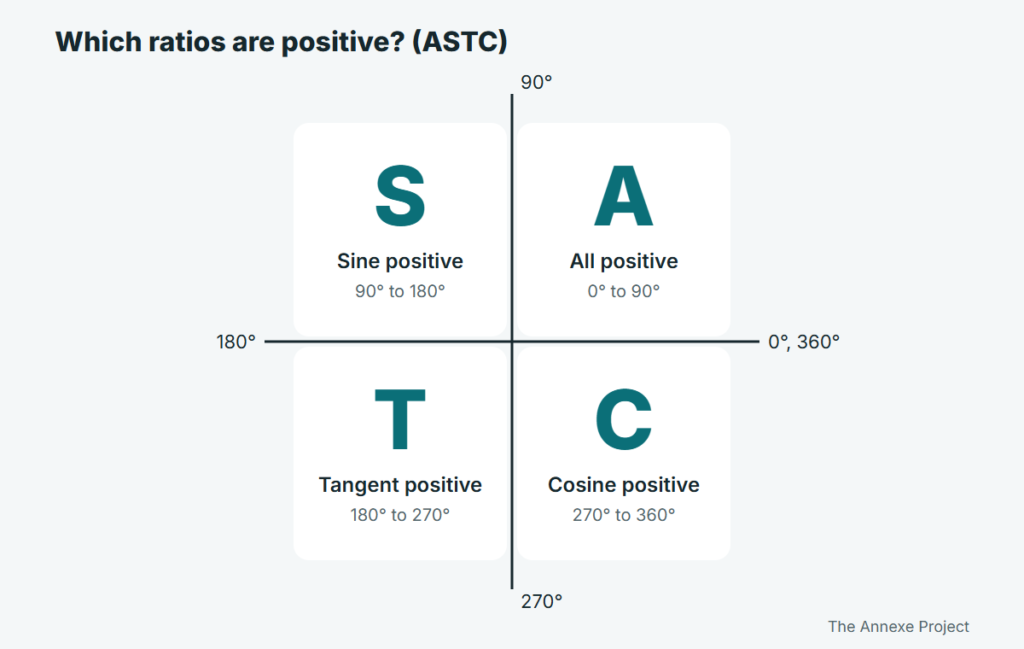
- Quadrants (ASTC): All positive in the first, Sine in the second, Tangent in the third, Cosine in the fourth.
| Angle | sin | cos | tan |
|---|---|---|---|
| 30° (π/6) | 1/2 | √3/2 | 1/√3 |
| 45° (π/4) | 1/√2 | 1/√2 | 1 |
| 60° (π/3) | √3/2 | 1/2 | √3 |
2. Pythagorean identities
- sin2A + cos2A = 1
- sec2A = 1 + tan2A
- cosec2A = 1 + cot2A
When to use: when an expression mixes squares of different ratios, or when you need to turn a sin2 into a cos2 (or the other way) so the whole equation is in one ratio. The second and third follow from the first: divide every term by cos2A or sin2A.
Worked example: proving an identity
Prove that tan2x − sin2x = sin2x tan2x.
Start from the left side and write tan2x as sin2x / cos2x.
LHS = sin2x / cos2x − sin2x
= sin2x (1 / cos2x − 1)
= sin2x (1 − cos2x) / cos2x
= sin2x · sin2x / cos2x (using sin2x = 1 − cos2x)
= sin2x tan2x = RHS as required.
When proving, work on one side only, usually the more complicated one, and turn everything into sin and cos if you are stuck.
3. Compound angle formulae
- sin(A ± B) = sin A cos B ± cos A sin B
- cos(A ± B) = cos A cos B ∓ sin A sin B
- tan(A ± B) = (tan A ± tan B) / (1 ∓ tan A tan B)
In the cos and tan lines, the sign flips: cos(A + B) has a minus in the middle, and tan(A + B) has a minus in the denominator. This is the most common sign slip we see.
When to use: to find exact values of angles such as 75° or 15°, or to expand an expression with two different angles.
Worked example: an exact value
Find the exact value of sin 75°.
Write 75° = 45° + 30°.
sin 75° = sin 45° cos 30° + cos 45° sin 30°
= (1/√2)(√3/2) + (1/√2)(1/2)
= (√3 + 1) / (2√2)
= (√6 + √2) / 4
Check on your calculator: both sides are about 0.9659.
4. Double angle formulae
- sin 2A = 2 sin A cos A
- cos 2A = cos2A − sin2A = 2cos2A − 1 = 1 − 2sin2A
- tan 2A = 2 tan A / (1 − tan2A)
These come straight from the compound angle formulae with B = A. The double angle formula for sin is the one students search for most, and it is the shortest to remember: sin 2A = 2 sin A cos A.
Which form of cos 2A? Pick the one that leaves a single ratio. If the equation has sin x as well, use 1 − 2sin2x. If it has cos x, use 2cos2x − 1.
Worked example 1: finding sin 2A from a ratio
Given sin A = 3/5 and A is acute, find sin 2A, cos 2A and tan 2A.
The right-angled triangle with opposite 3 and hypotenuse 5 has adjacent 4, so cos A = 4/5.
sin 2A = 2 (3/5)(4/5) = 24/25
cos 2A = 1 − 2 (3/5)2 = 1 − 18/25 = 7/25
tan 2A = sin 2A / cos 2A = 24/7
Worked example 2: solving an equation
Solve cos 2x + 3 sin x = 2 for 0° ≤ x ≤ 360°.
The equation has sin x, so use cos 2x = 1 − 2sin2x.
1 − 2sin2x + 3 sin x = 2
2sin2x − 3 sin x + 1 = 0
(2 sin x − 1)(sin x − 1) = 0
So sin x = 1/2 or sin x = 1.
- sin x = 1/2: the basic angle is 30°, and sine is positive in the first and second quadrants, so x = 30° or 150°.
- sin x = 1: x = 90°.
Answer: x = 30°, 90°, 150°.
Not sure which identity to reach for when a question is not labelled? That judgement is what we practise in A Math tuition, using real exam questions, as part of our live online math tuition.
An H2 tip: double angle formulae for integration
Rearranging the cos 2A forms gives two results that H2 students use all the time in Integration:
- cos2x = (1 + cos 2x) / 2
- sin2x = (1 − cos 2x) / 2
These let you integrate sin2x and cos2x, which have no direct standard result. In H2, angles are often in radians, so check your calculator mode before every question.
5. The R-formula (harmonic form)
This rewrites a sum of sine and cosine as one wave. It is in both syllabuses but is not printed in the formula list, so learn the method.
- a sin θ + b cos θ = R sin(θ + α)
- a sin θ − b cos θ = R sin(θ − α)
- a cos θ + b sin θ = R cos(θ − α)
- a cos θ − b sin θ = R cos(θ + α)
- In each case, a and b are positive, R = √(a2 + b2) and α is acute. Find α from the two equations you get by comparing coefficients, as in the example below.
The reliable way is not to memorise the list but to expand the right-hand side and compare. For R sin(θ + α) = R sin θ cos α + R cos θ sin α, so R cos α is the coefficient of sin θ and R sin α is the coefficient of cos θ.
When to use: to find the maximum or minimum of a sin θ + b cos θ, or to solve a sin θ + b cos θ = c.
Worked example
(a) Express 3 sin x + 4 cos x in the form R sin(x + α), where R > 0 and α is acute.
R cos α = 3 and R sin α = 4. So R = √(32 + 42) = 5, and tan α = 4/3, which gives α = 53.13° (2 decimal places).
3 sin x + 4 cos x = 5 sin(x + 53.13°)
(b) State the maximum value and the smallest positive x at which it occurs.
The maximum value is 5, when sin(x + 53.13°) = 1. So x + 53.13° = 90°, giving x = 36.87°.
(c) Solve 3 sin x + 4 cos x = 2.5 for 0° ≤ x ≤ 360°.
5 sin(x + 53.13°) = 2.5, so sin(x + 53.13°) = 0.5.
The range for x + 53.13° is 53.13° to 413.13°. In this range the angles with sine 0.5 are 150° and 390°.
x = 150° − 53.13° = 96.87° or x = 390° − 53.13° = 336.87°.
Note that 30° is outside the range, so it is not used. Checking the range first is a common place to lose a mark.
6. Sine rule, cosine rule and area of a triangle
For triangle ABC with sides a, b, c opposite angles A, B, C (all printed in the 4049 formula list):
- Sine rule: a / sin A = b / sin B = c / sin C
- Cosine rule: a2 = b2 + c2 − 2bc cos A
- Area = ½ bc sin A
When to use: the sine rule when you know a matching side and angle pair. The cosine rule when you know two sides and the angle between them, or all three sides.
Worked example
In triangle ABC, a = 7 cm, b = 8 cm and angle C = 60°. Find side c and the area.
c2 = 72 + 82 − 2(7)(8) cos 60° = 49 + 64 − 56 = 57, so c = 7.55 cm (3 significant figures).
Area = ½ (7)(8) sin 60° = 28 × (√3/2) = 14√3 = 24.2 cm2 (3 significant figures).
Graphs of trigonometric functions, including tan
The 4049 syllabus asks for graphs of y = a sin(bx) + c, y = a cos(bx) + c and y = a tan(bx), where a is real, b is a positive integer and c is an integer (for tan, the syllabus form has no c). Here is what each number does.
| Graph | Period | Key features |
|---|---|---|
| y = a sin(bx) + c | 360° / b | Amplitude |a|. Centre line y = c. Starts at the centre line and rises (if a is positive). |
| y = a cos(bx) + c | 360° / b | Amplitude |a|. Centre line y = c. Starts at a maximum (if a is positive). |
| y = a tan(bx) | 180° / b | No amplitude. Passes through the origin. Vertical asymptotes between each branch. Goes from negative to positive infinity within each branch. |
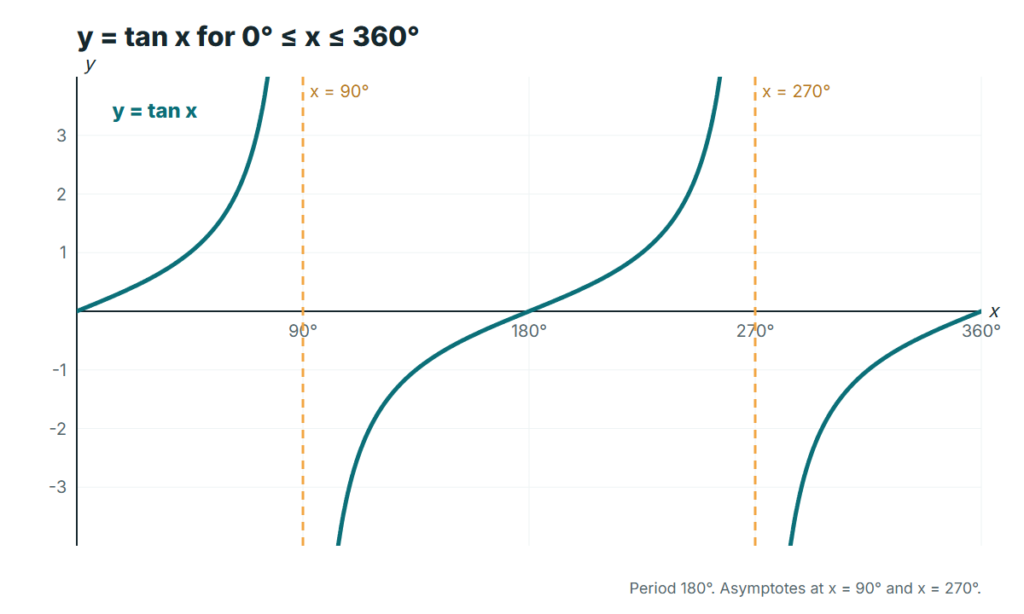
How to sketch a tan graph
- Find the period: 180° / b (or π / b in radians).
- The graph passes through the origin and through every point where x is a multiple of the period.
- The asymptotes sit halfway between those points. For y = tan x they are at x = 90° and 270°, and so on, and for y = tan 2x they are at x = 45°, 135°, and so on.
- The value a stretches the graph vertically, so the curve gets steeper (a large) or flatter (a small). Because tan has no maximum, a changes steepness, not height.
Quick check: y = tan 2x for 0° ≤ x ≤ 180° has period 90°. It crosses the x-axis at 0°, 90° and 180°, with asymptotes at x = 45° and x = 135°.
A sin example: y = 2 sin 3x + 1 has amplitude 2, period 120°, maximum value 3 and minimum value −1.
Common mistakes
- Writing sin(A + B) = sin A + sin B. It is not.
- Getting the sign wrong in the cos and tan compound angle formulae.
- Writing sin2A as sin A2. The square belongs to the whole sin A.
- Dividing both sides of an equation by cos x or sin x and losing solutions. Factorise instead.
- Stopping at the basic angle and not listing every angle in the range.
- Leaving the calculator in radians when the question is in degrees, or the reverse.
How to practise
Write the whole list from memory, check it against this page, then repeat a few days later. After that, try full trigonometry questions from past papers and compare your working line by line with a model solution. Our model solutions library has worked solutions to past papers, including the 2025 O-Level A Math Paper 1, the 2024 O-Level A Math Paper 2 and the 2025 H2 Mathematics Paper 1.
If you would like a tutor to find where your trigonometry marks are going, see our A Math tuition for O-Level students and our H2 Math tuition for JC students. For the full H2 formula booklet, read our MF27 formula list guide.
Frequently asked questions
Which trig identities must I memorise for A Math?
The formula list printed in the 4049 paper gives the Pythagorean, compound angle, double angle and triangle formulae. You must still know tan A = sin A / cos A, the exact values for 30°, 45° and 60°, the quadrant signs and the method for the R-formula. Knowing the printed formulae well still saves time.
Does MF27 include the Pythagorean identities?
No. The trigonometry section of MF27 prints the compound angle formulae, the double angle formulae and the principal values of the inverse functions. sin2A + cos2A = 1 and its relatives are not printed, so H2 students must memorise them.
What is the double angle formula for sin?
sin 2A = 2 sin A cos A. It follows from the compound angle formula sin(A + B) = sin A cos B + cos A sin B by putting B = A.
Which form of cos 2A should I use?
Use the form that leaves one ratio. With sin x elsewhere in the equation, use 1 − 2sin2x. With cos x, use 2cos2x − 1. Use cos2x − sin2x when the expression has both and you plan to factorise.
What is the period of the tan graph?
y = tan x repeats every 180° (π radians). For y = a tan(bx), the period is 180° / b. Tan has vertical asymptotes, so it has no amplitude.
