
The short answer
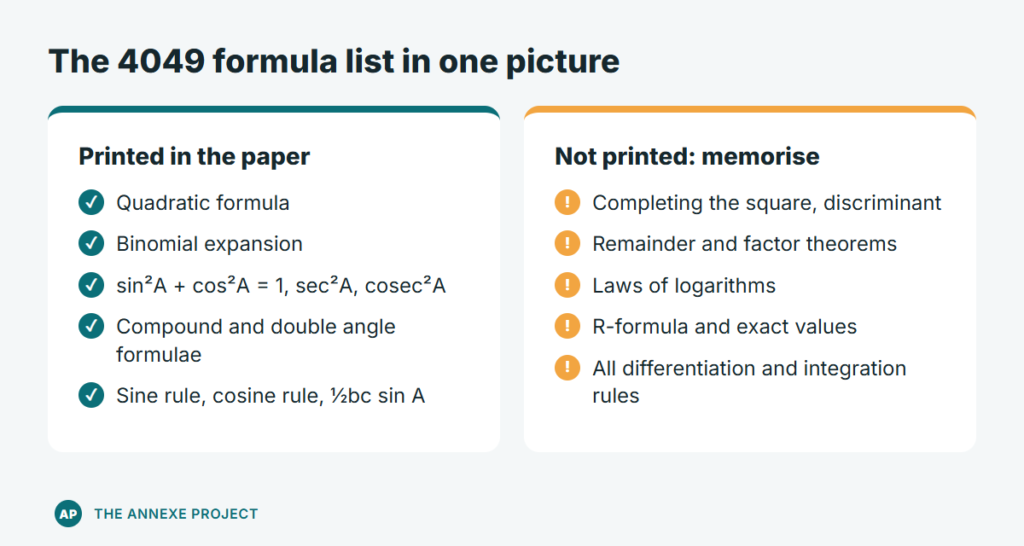
the O-Level A-Math (4049) paper prints only a short formula list: the quadratic formula, the binomial expansion, the trigonometric identities and the triangle formulae (sine rule, cosine rule and area). Everything else, including completing the square, the discriminant, logarithm laws, the remainder and factor theorems, partial fractions, the R-formula, and all differentiation and integration rules, you must know by heart. This guide separates the two lists, topic by topic, with a worked example for each key area.
On this page
- What does the A-Math formula sheet actually give you?
- What must you memorise for A-Math?
- Algebra: completing the square and the discriminant
- Partial fractions
- Binomial theorem
- Logarithms and exponentials
- Trigonometry: identities and the R-formula
- Calculus: differentiation and integration
- How to use this sheet to revise
- Frequently asked questions
- Want help turning formulas into marks?
It is written for Sec 3 and Sec 4 students taking Additional Mathematics, and for parents who want to know what to check at home. If you also sit E-Math, our O-Level Maths formula sheet for E-Math and A-Math covers both papers on one page. This post goes deeper on A-Math only.
What does the A-Math formula sheet actually give you?
The 4049 syllabus from SEAB states that relevant mathematical formulae are provided for candidates, and it prints a “Mathematical Formulae” page with exactly these results. We checked this against the 2026 syllabus document.
| Topic | Printed in the paper |
|---|---|
| Algebra | Quadratic formula: for ax² + bx + c = 0, x = (−b ± √(b² − 4ac)) ÷ 2a |
| Algebra | Binomial expansion: (a + b)ⁿ = aⁿ + ⁿC₁ aⁿ⁻¹b + ⁿC₂ aⁿ⁻²b² + … + ⁿCᵣ aⁿ⁻ʳbʳ + … + bⁿ, where n is a positive integer and ⁿCᵣ = n! ÷ (r!(n − r)!) |
| Trigonometry | sin²A + cos²A = 1, sec²A = 1 + tan²A, cosec²A = 1 + cot²A |
| Trigonometry | sin(A ± B) = sin A cos B ± cos A sin B; cos(A ± B) = cos A cos B ∓ sin A sin B; tan(A ± B) = (tan A ± tan B) ÷ (1 ∓ tan A tan B) |
| Trigonometry | sin 2A = 2 sin A cos A; cos 2A = cos²A − sin²A = 2cos²A − 1 = 1 − 2sin²A; tan 2A = 2 tan A ÷ (1 − tan²A) |
| Triangle ABC | Sine rule: a ÷ sin A = b ÷ sin B = c ÷ sin C; cosine rule: a² = b² + c² − 2bc cos A; area = ½ bc sin A |
That is the whole list. Notice what is missing. Many students assume the printed page covers the paper, then freeze when a question needs a result that is not on it. (This list is from the 2026 SEAB 4049 syllabus.)
What must you memorise for A-Math?
These results are in the syllabus but not on the printed page. Use this as your checklist.
- Quadratics: completing the square, and the discriminant b² − 4ac (above 0: two real roots; equal to 0: two equal roots; below 0: no real roots).
- Polynomials: the remainder theorem, the factor theorem, and the cubic identities a³ + b³ = (a + b)(a² − ab + b²) and a³ − b³ = (a − b)(a² + ab + b²).
- Logarithms and indices: the laws of logarithms and the change of base formula.
- Trigonometry: sin A ÷ cos A = tan A, cos A ÷ sin A = cot A, exact values for 30°, 45° and 60°, and the R-formula.
- Coordinate geometry: midpoint, parallel and perpendicular gradient conditions, area of a rectilinear figure, and the circle equation.
- Calculus: the standard derivatives and integrals, plus the product, quotient and chain rules.
Algebra: completing the square and the discriminant
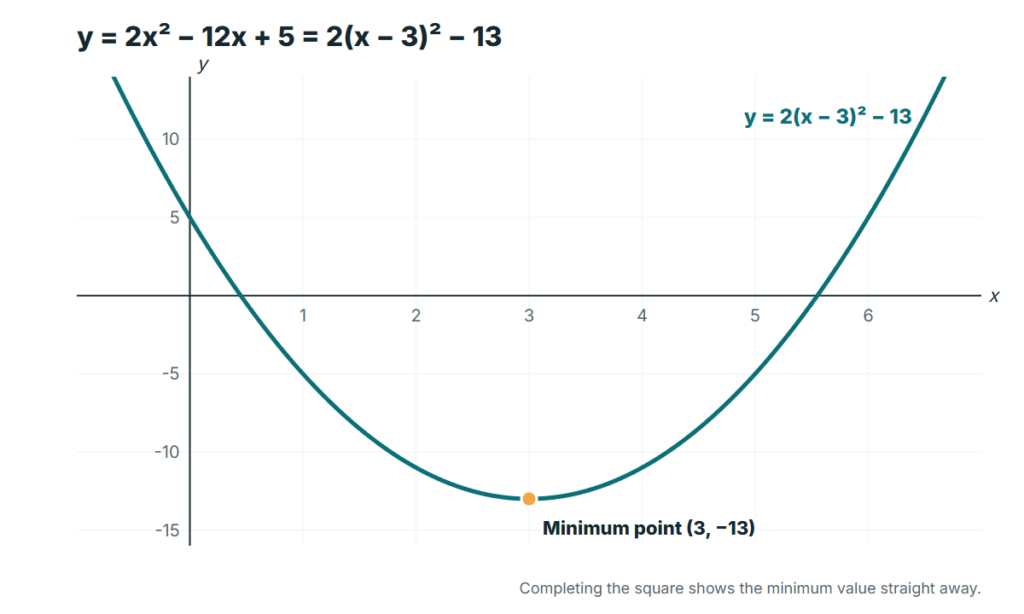
Neither result is printed, and both appear in almost every paper. Completing the square rewrites ax² + bx + c as a(x + h)² + k. The minimum (or maximum) value is k, and it happens at x = −h.
Worked example. Express 2x² − 12x + 5 in the form a(x + h)² + k, and state its minimum value.
- Take out the 2 from the first two terms: 2(x² − 6x) + 5.
- Complete the square inside the bracket: x² − 6x = (x − 3)² − 9.
- Put it back: 2[(x − 3)² − 9] + 5 = 2(x − 3)² − 18 + 5 = 2(x − 3)² − 13.
The minimum value is −13, when x = 3.
The discriminant is used whenever a question talks about a line and a curve meeting. Substitute the line into the curve, form a quadratic, then use b² − 4ac.
Worked example. Find the value of k for which the line y = x + k is a tangent to the curve y = x² − 3x + 5.
Set the equations equal: x + k = x² − 3x + 5, so x² − 4x + (5 − k) = 0. A tangent touches the curve once, so b² − 4ac = 0: (−4)² − 4(1)(5 − k) = 0, which gives 16 − 20 + 4k = 0, so k = 1. As a check, x² − 4x + 4 = (x − 2)², a repeated root, as a tangent should give.
Polynomials and the remainder and factor theorems
If f(x) is divided by (x − a), the remainder is f(a). If f(a) = 0, then (x − a) is a factor.
Worked example. Factorise f(x) = x³ − 2x² − 5x + 6 completely.
Try x = 1: f(1) = 1 − 2 − 5 + 6 = 0, so (x − 1) is a factor. Dividing gives x³ − 2x² − 5x + 6 = (x − 1)(x² − x − 6) = (x − 1)(x − 3)(x + 2).
Stuck on when to use which result? Knowing the formula is half the job. Choosing the right one under exam pressure is the other half, and that is what we train in our live A-Math tuition classes, part of our online math tuition.
Partial fractions
Partial fractions are not on the printed list. The 4049 syllabus covers denominators of these types: (ax + b)(cx + d), (ax + b)(cx + d)² and (ax + b)(x² + c²). The method is to write the fraction as a sum with unknown numerators, multiply through, then substitute convenient values of x.
Worked example. Express (5x + 1) ÷ [(x − 1)(x + 2)] in partial fractions.
- Write it as A ÷ (x − 1) + B ÷ (x + 2).
- Multiply through: 5x + 1 = A(x + 2) + B(x − 1).
- Let x = 1: 6 = 3A, so A = 2.
- Let x = −2: −9 = −3B, so B = 3.
So (5x + 1) ÷ [(x − 1)(x + 2)] = 2 ÷ (x − 1) + 3 ÷ (x + 2). Check with x = 0: the left side is −½, and 2 ÷ (−1) + 3 ÷ 2 = −½. For a repeated factor (cx + d)², include both a term over (cx + d) and a term over (cx + d)².
Binomial theorem
The expansion is printed, so you do not need to memorise it. You do need to use the general term correctly. The term containing aⁿ⁻ʳbʳ is ⁿCᵣ aⁿ⁻ʳ bʳ, counting r from 0.
Worked example. Find the term independent of x in the expansion of (x + 2 ÷ x²)⁶.
The general term is ⁶Cᵣ x⁶⁻ʳ (2 ÷ x²)ʳ = ⁶Cᵣ 2ʳ x⁶⁻³ʳ. For the term independent of x, set 6 − 3r = 0, so r = 2. The term is ⁶C₂ × 2² = 15 × 4 = 60.
Logarithms and exponentials
The laws of logarithms are not printed, so memorise them: logₐ(xy) = logₐx + logₐy; logₐ(x ÷ y) = logₐx − logₐy; logₐxⁿ = n logₐx; and the change of base logₐx = log_b x ÷ log_b a.
Worked example. Solve log₂x + log₂(x − 2) = 3.
Combine: log₂[x(x − 2)] = 3, so x(x − 2) = 2³ = 8. Then x² − 2x − 8 = 0, so (x − 4)(x + 2) = 0. Logarithms need positive inputs, so x = −2 is rejected. The answer is x = 4. Always check your roots against the domain; that is where marks are lost.
Trigonometry: identities and the R-formula
The identities and double-angle formulae are printed. What is not printed is sin A ÷ cos A = tan A, cos A ÷ sin A = cot A, the exact values for 30°, 45° and 60°, and the R-formula, which rewrites a sin θ + b cos θ as a single sine or cosine. For every identity with a worked example, see our trigonometric identities cheat sheet.
Worked example (proving an identity). Prove that (1 − cos 2A) ÷ sin 2A = tan A.
Use cos 2A = 1 − 2sin²A and sin 2A = 2 sin A cos A. The numerator becomes 2sin²A and the denominator 2 sin A cos A. Cancel 2 sin A to get sin A ÷ cos A = tan A. Start from the more complicated side and work towards the simpler one.
Worked example (R-formula). Express 3 sin θ + 4 cos θ in the form R sin(θ + α), where R > 0 and α is acute.
Expand R sin(θ + α) = R cos α sin θ + R sin α cos θ. Match coefficients: R cos α = 3 and R sin α = 4. Then R = √(3² + 4²) = 5 and tan α = 4 ÷ 3, so α = 53.1° (to 1 decimal place). So 3 sin θ + 4 cos θ = 5 sin(θ + 53.1°), and its greatest value is 5.
Calculus: differentiation and integration
Nothing in calculus is printed, so this is the biggest block to memorise.
- d/dx (xⁿ) = nxⁿ⁻¹; d/dx (eˣ) = eˣ; d/dx (ln x) = 1 ÷ x
- d/dx (sin x) = cos x; d/dx (cos x) = −sin x; d/dx (tan x) = sec²x
- Product rule: d/dx (uv) = u (dv/dx) + v (du/dx)
- Quotient rule: d/dx (u ÷ v) = [v (du/dx) − u (dv/dx)] ÷ v²
- Chain rule: dy/dx = dy/du × du/dx
- ∫ xⁿ dx = xⁿ⁺¹ ÷ (n + 1) + c, for n ≠ −1
- ∫ (ax + b)ⁿ dx = (ax + b)ⁿ⁺¹ ÷ [a(n + 1)] + c, for n ≠ −1
- ∫ eˣ dx = eˣ + c; ∫ sin x dx = −cos x + c; ∫ cos x dx = sin x + c; ∫ sec²x dx = tan x + c
Worked example (differentiation). Find the gradient of y = x² e³ˣ at x = 0.
Use the product rule with u = x² and v = e³ˣ. Then dy/dx = x² × 3e³ˣ + e³ˣ × 2x. At x = 0 both terms are 0, so the gradient is 0.
Worked example (integration). Find ∫ (2x + 1)³ dx.
With a = 2 and n = 3, the answer is (2x + 1)⁴ ÷ (2 × 4) + c = (2x + 1)⁴ ÷ 8 + c. Differentiate your answer to check: 4(2x + 1)³ × 2 ÷ 8 = (2x + 1)³.
How to use this sheet to revise
- Cover the right-hand side of each “must memorise” item and write it from memory.
- Do one past-paper question on the topic straight away.
- Mark your working against a full solution and note which result you forgot.
- Repeat the weak ones the next day.
For full worked answers, use our model solutions for 2024 A-Math Paper 1, 2025 A-Math Paper 1 and 2025 A-Math Paper 2. Each step is written out, so you can see where the formulae above are used. The full set is in the model solutions library.
Frequently asked questions
Is a formula sheet given in the O-Level A-Math exam?
Yes, but it is short. It gives the quadratic formula, the binomial expansion, the trigonometric identities and the triangle formulae. You must memorise the rest, including calculus rules and logarithm laws.
Is the R-formula given in the A-Math paper?
No. The R-formula is in the syllabus but is not on the printed formula list, so you need to know how to derive and use it.
Do I need to memorise the binomial theorem for A-Math?
You do not need to memorise the expansion because it is printed. You do need to know how to pick out a specific term using ⁿCᵣ aⁿ⁻ʳbʳ.
Can I bring my own formula sheet into the A-Math exam?
No. You only get the formulae printed in the question paper, so revise your own list until you can write it from memory.
What is the difference between the E-Math and A-Math formula sheets?
E-Math (4052) has its own printed list, mostly mensuration, trigonometry and statistics. A-Math (4049) prints algebra and trigonometry results only. See our E-Math and A-Math formula sheet for the E-Math side.
Want help turning formulas into marks?
A formula sheet helps you recall. It does not teach you when to use a result, and that is where most A-Math marks are won or lost. The Annexe Project has taught O-Level and A-Level mathematics online since 2008, when Mr Alvin Yeo founded it. Find out how the classes work on our A-Math tuition page, or start practising now with the A-Math model solutions.
