
The short answer
O-Level Additional Mathematics (A-Math, syllabus 4049) has three strands: Algebra, Geometry and Trigonometry, and Calculus. It is examined in two papers of 2 hours 15 minutes, each worth 90 marks and 50% of the grade, and a calculator is allowed in both. From 2027, the O-Level is replaced by the Singapore-Cambridge Secondary Education Certificate (SEC), and A-Math becomes G3 Additional Mathematics (syllabus K341), with the same three strands and the same two-paper format.
On this page
Which syllabus applies to you
Singapore is moving from the GCE O-Level to the Singapore-Cambridge Secondary Education Certificate (SEC). For A-Math, this mostly changes the name and the syllabus code, not what you study.
| Exam year | Exam | A-Math syllabus |
|---|---|---|
| 2026 and earlier | GCE O-Level | Additional Mathematics, syllabus 4049 |
| 2027 onwards | SEC (Secondary Education Certificate) | G3 Additional Mathematics, syllabus K341 |
Both versions are set by MOE and Cambridge and published by SEAB. The 2027 syllabus keeps the same topics (A1 to A6, G1 to G3 and C1), the same two papers and the same marks. If you are in Secondary 3 now, check with your school which code your paper will carry, then use this page as your topic checklist.
How A-Math is examined
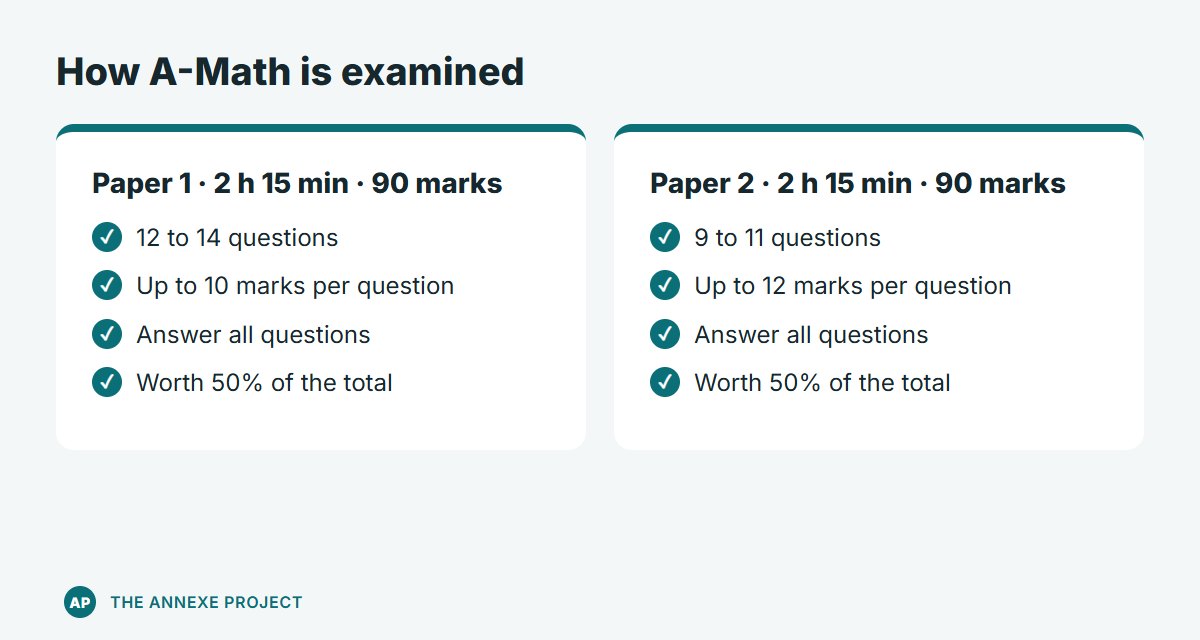
| Paper | Duration | Questions | Marks | Weighting |
|---|---|---|---|---|
| Paper 1 | 2 h 15 min | 12 to 14 questions, up to 10 marks each | 90 | 50% |
| Paper 2 | 2 h 15 min | 9 to 11 questions, up to 12 marks each | 90 | 50% |
- You must answer all questions in both papers. There is no choice of questions.
- An approved calculator may be used in both papers.
- Leaving out essential working loses marks, even when the final answer is right.
- Non-exact answers are given to 3 significant figures, or 1 decimal place for angles in degrees, unless the question says otherwise.
Paper 2 has fewer but longer questions, so it rewards students who can keep a long piece of working tidy. Our free A-Math past-paper model solutions show what full marks working looks like for both papers.
The full list of A-Math topics
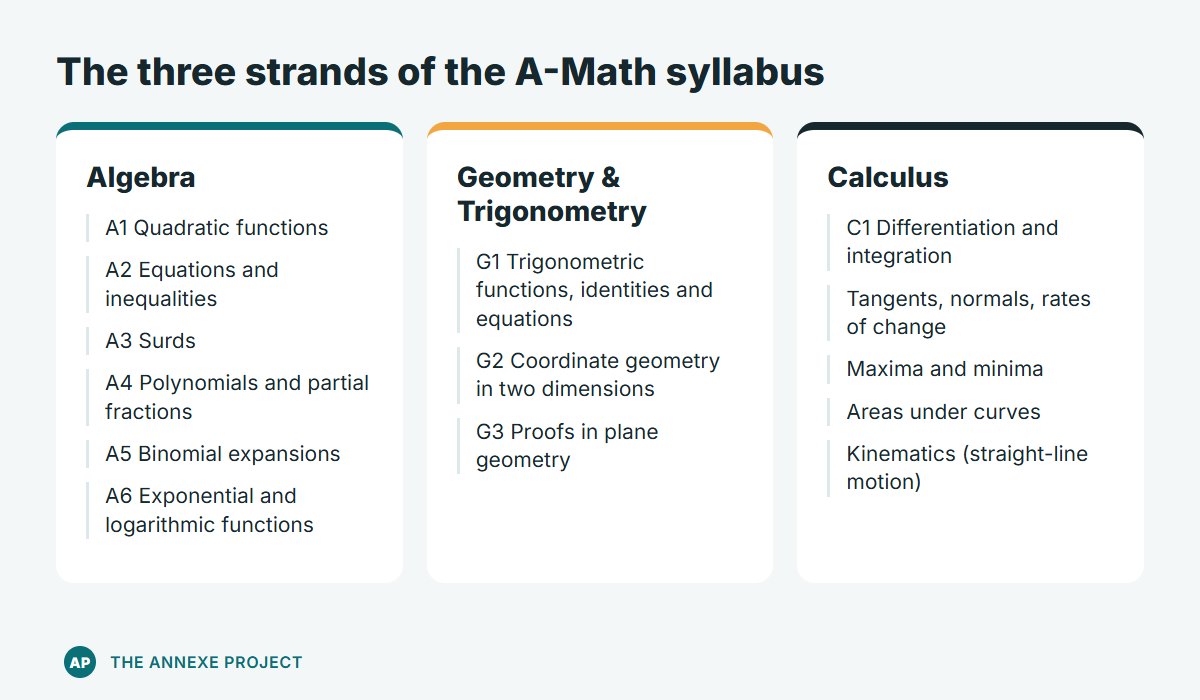
Algebra
- A1 Quadratic functions: finding the maximum or minimum value by completing the square, conditions for a quadratic to be always positive or always negative, and quadratics as models.
- A2 Equations and inequalities: conditions for two real roots, equal roots or no real roots, and when a line meets, touches or misses a curve; simultaneous equations where one is linear; quadratic inequalities on a number line.
- A3 Surds: the four operations, rationalising the denominator, and solving equations with surds.
- A4 Polynomials and partial fractions: multiplying and dividing polynomials, the remainder and factor theorems, solving cubic equations, the sum and difference of two cubes, and partial fractions with denominators no harder than (ax + b)(cx + d), (ax + b)(cx + d)2 and (ax + b)(x2 + c2).
- A5 Binomial expansions: the binomial theorem for positive integer n, the notations n! and ⁿCᵣ, and the general term. The greatest term is not required.
- A6 Exponential and logarithmic functions: ax, ex, loga x and ln x and their graphs, the laws of logarithms, change of base, solving equations, and exponential models.
Geometry and Trigonometry
- G1 Trigonometric functions, identities and equations: all six ratios for any angle in degrees or radians, principal values, exact values for 30°, 45° and 60°, graphs of sine, cosine and tangent, the compound and double angle formulae, the R-formula, proving identities, and solving equations in a given interval. See our trigonometric identities cheat sheet.
- G2 Coordinate geometry in two dimensions: parallel and perpendicular lines, midpoints, areas of rectilinear figures, equations of circles, and turning relationships such as y = axn and y = kbx into straight-line form to find unknown constants.
- G3 Proofs in plane geometry: using properties of parallel lines, triangles, quadrilaterals and circles, congruent and similar triangles, the midpoint theorem and the tangent-chord (alternate segment) theorem.
Calculus
- C1 Differentiation and integration: the derivative as a gradient and a rate of change; derivatives of xn, sin x, cos x, tan x, ex and ln x; the product, quotient and chain rules; increasing and decreasing functions; stationary points and the second derivative test; tangents, normals, connected rates of change and maxima and minima problems.
- Integration as the reverse of differentiation, definite integrals, areas bounded by a curve and lines (including regions below the x-axis), and kinematics: displacement, velocity and acceleration of a particle moving in a straight line.
Want a tutor to take you through these topics one by one? Our live O-Level A-Math tuition covers the full syllabus with Mr Alvin Yeo, as part of our online math tuition for Singapore students.
What the exam tests beyond topics
Knowing the topics is only part of the grade. The syllabus sets three assessment objectives, with these approximate weightings:
- AO1, use and apply standard techniques (35%): recalling facts and carrying out routine methods.
- AO2, solve problems in a variety of contexts (50%): choosing the right method, linking topics and interpreting answers in context.
- AO3, reason and communicate mathematically (15%): justifying statements, explaining, and writing proofs.
Half of the marks reward problem solving, not routine practice. A student who only drills textbook exercises can do well in class tests and still lose marks on unfamiliar exam questions. Past papers are the best way to train AO2.
Formulae given in the exam
The paper prints a short list of formulae: the quadratic formula, the binomial expansion, the main trigonometric identities (including the compound and double angle formulae), and the sine rule, cosine rule and area of a triangle. Everything else, including the laws of logarithms, the R-formula and every differentiation and integration rule, must be memorised. Our A-Math formula sheet lists exactly what is given and what to learn by heart.
How to prepare
- Secure algebra first. Quadratics, surds, indices and logarithms appear inside almost every calculus and trigonometry question.
- Learn trigonometry early. Identities and the R-formula take time to become automatic.
- Write full working every time. Missing steps cost marks under the marking scheme.
- Do full papers under time. Each paper is 2 hours 15 minutes with no choice of questions, so pace matters.
- Mark your work against full solutions, not just final answers, to see where method marks are lost.
A-Math is also the foundation for A-Level H2 Mathematics. The syllabus itself says it prepares students for H2, so a strong A-Math grade makes JC much easier.
Frequently asked questions
What is the A-Math syllabus code?
For the GCE O-Level it is 4049. From 2027, under the Singapore-Cambridge Secondary Education Certificate (SEC), the subject is called G3 Additional Mathematics and the syllabus code is K341.
What topics are in O-Level A-Math?
Ten topics in three strands. Algebra: quadratic functions, equations and inequalities, surds, polynomials and partial fractions, binomial expansions, and exponential and logarithmic functions. Geometry and Trigonometry: trigonometric functions, identities and equations, coordinate geometry, and proofs in plane geometry. Calculus: differentiation and integration.
How long are the A-Math papers?
Both Paper 1 and Paper 2 are 2 hours 15 minutes long and worth 90 marks each, so each paper counts for 50% of the final grade.
Is a calculator allowed in A-Math?
Yes. An approved calculator may be used in both Paper 1 and Paper 2.
Does the A-Math syllabus change in 2027?
The exam becomes the SEC and the code changes from 4049 to K341, but the 2027 syllabus keeps the same three strands, the same topics and the same two papers of 90 marks each.
Is A-Math compulsory?
No. A-Math is an elective subject. Mathematics (E-Math) is the compulsory one, and our guide explains the difference between E-Math and A-Math. Many students take A-Math because it is the foundation for H2 Mathematics at JC.
